
Retiring as a Federal LEO? Why Your TSP Needs a Bucket Strategy

Two Risks, One Pile
Part 1 of a three-part series on the TSP bucket strategy for federal law enforcement retirees
You’ve spent years, maybe decades, building your TSP. You took full advantage of the agency match. You stayed the course with the C, S and I Funds, even when the G Fund looked awfully tempting during those ugly market stretches. You did the hard part.
And now you’re ready to retire!
If you’re like most of my clients, you have two goals for that money. First, you want your TSP to support the life you’ve built for yourself. Second, you don’t want to run out of money. (Yeah, who wants that?)
But hitting both goals takes a different approach to investing. It’s one you’ve never, ever, ever had to use before.
For your entire career, your TSP had one job: grow. You put money in every pay period, you didn’t need to touch it, and a market crash just meant buying shares on sale. In retirement, that changes overnight. Your TSP now has two jobs. Job one: protect the money you’ll need in the next few years from a bad market. Job two: keep growing enough to keep up with prices over a retirement that could last 30, 35, even 40 years.
But here’s the problem nobody tells you about at the retirement seminar:
Those two jobs work against each other.
The thing that solves one problem makes the other one worse.
Read that again. It’s the single most important idea in this series. Protect too much, and your money can’t keep up with 30-plus years of rising prices. Grow too much, and one bad market at the wrong time can sink your plan. Every retirement investing decision you make lives inside that tension.
In this first article, we’ll break down both risks, the antidote to each, and why trying to handle both inside one pile of money is a losing game. In Parts 2 and 3, we’ll show you how the bucket strategy solves it.
Risk #1: The Bad-Timing Trap (sequence of returns risk)
While you’re working, a market crash is almost a gift. Your TSP contributions buy shares on sale, and you have years to wait for the recovery.
In retirement, the math flips. You’re selling shares every year to create your paycheck. If the market drops early in retirement, you have to sell more shares at low prices to raise the same income. Those shares are gone, and they never get to ride the recovery.
That’s sequence of returns risk: the order of your returns matters as much as the average. Two retirees can earn the exact same average return and end up in completely different places, just because the bad years came at a different time.
Here’s what that looks like with real S&P 500 returns. Both hypothetical retirees start with $1 million and take $50,000 in year one, raising it 3% a year for inflation. One gets the actual returns from 2000 to 2019, which started with the dot-com crash. The other gets the same 20 returns in reverse order.[1]
S&P 500 total returns 2000–2019 (Slickcharts) · hypothetical withdrawals, no fees or taxes
Both retirees earned the same 7.7% average annual return over the 20 years.[1] Without withdrawals, they’d have finished with exactly the same amount, because order doesn’t matter when you’re only adding or holding. Once withdrawals started, the retiree who hit the bad years first ran out of money in year 16. The one who got the good years first finished with about $1.5 million.
For a federal LEO retiring in their 50s, those first few years are the danger zone. A crash right after you turn in your badge can do damage that 30 good years later can’t undo.
The antidote to Risk #1: protection
If a bad market early in retirement is the danger, the fix is simple: don’t let the money you need soon ride the market.
That means keeping your next several years of withdrawals in places that don’t drop when stocks do. Think the G Fund, money market funds, CDs and short-term Treasuries. When the market falls 30%, that money is still there, and you can keep paying your bills without selling a single share at a loss.
Protection buys you the one thing a retiree needs most in a crash: time. Time for the market to recover before you ever have to touch your stock investments.
So why not just protect everything?
Honestly, that’s the instinct I run into most. The old rule that you should “get conservative” in retirement isn’t something I usually have to sell anyone on. In fact, I’ve seen plenty of folks stay 100% aggressive right up until the day they submit their retirement application, then move everything to the G Fund.
The logic sounds airtight: “I’m retired now. I don’t have time to wait for the market to come back.”
But that logic has a hidden flaw. You do have time. Just not for all of your money.
Retiring at 55 or 57 doesn’t mean you need every dollar tomorrow. You’ll spend that money over the next 30 or 40 years. The dollars you’ll withdraw at 80 or 85 still have decades to work. Park all of them in safe investments for that whole stretch, and they face a slower, quieter risk that can do just as much damage as a market crash..
That risk is inflation.
Risk #2: The Silent Paycheck Thief (inflation over a 30- to 40-year retirement)
Most Americans retire in their mid-60s and plan for 20 to 25 years of retirement. Federal LEOs don’t get that luxury. With mandatory retirement at 57, and many of you leaving in your early-to-mid 50s, your money may need to last 30, 35 or even 40 years.[2] You could be retired longer than you carried a badge.
That long runway turns inflation from an annoyance into a real threat. Prices don’t have to spike to do damage. They just have to keep rising, year after year.
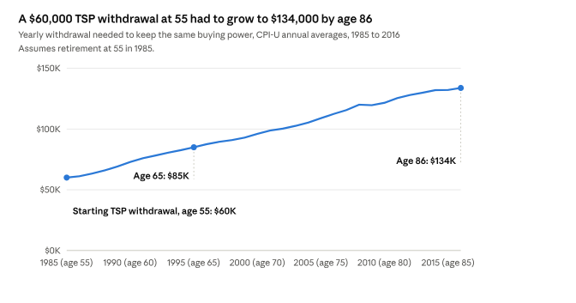
Here’s what three decades of ordinary inflation do to the amount you have to pull from your TSP. Picture an agent who retired at 55 in 1985 and needed to withdraw $60,000 a year from savings to live.
BLS CPI-U annual averages 1985–2016 (US Inflation Calculator) · hypothetical $60,000 starting withdrawal
Prices rose about 2.6% a year on average over that stretch, nothing dramatic. Even so, to buy the same things, that agent’s withdrawal had to grow to about $85,000 by age 65 and about $134,000 by age 86. That’s more than double the starting amount, just to stand still.[3]
FERS was designed as a three-legged stool: your FERS annuity, Social Security and your TSP. Two of those legs come with built-in cost-of-living adjustments. Social Security gets one every year, and so does your FERS annuity.[4]
The third leg, your TSP, has no COLA at all. So here’s the question every retiring fed needs to answer: where is your TSP’s cost-of-living raise going to come from?
Not the G Fund, that’s for sure. Its job is to protect your principal, not to outrun 30-plus years of rising prices.
If your TSP is going keep up with gas prices and groceries, much less give you a raise, that raise has to come from growth.
The antidote to Risk #2: growth
To stay ahead of 30 to 40 years of rising prices, part of your money has to grow faster than inflation. Historically, that has meant stocks.
From 1928 through 2025, the S&P 500 compounded at about 9.9% a year with dividends reinvested, or about 6.6% a year after inflation, according to calculations using Robert Shiller’s data.[5] Safe investments like the G Fund protect your principal, but over long stretches they have struggled to stay much ahead of inflation.
But growth has a price tag, and you already know what it is: market risk. That same S&P 500 finished the year lower in 26 of those 98 years, roughly one year in four.[5] Some of those years were brutal.
And a big drop at the wrong time brings us right back to Risk #1.
The catch: each antidote feeds the other risk
Here’s where it gets frustrating. Put the two risks side by side:
| Sequence of returns risk | Inflation risk | |
| The antidote | Protection | Growth |
| What the antidote does to the other risk | More protection means less growth, so inflation wins | More growth means more market exposure, so a bad sequence can sink you |
Play it too safe, and inflation quietly eats your lifestyle over 30 years. Swing for growth, and one bad stretch early on can do damage you never recover from.
Most retirees respond by picking a “balanced” mix, something like 60/40, and hoping it’s a reasonable middle ground. But a middle ground is also a compromise. That one portfolio is a little too risky for the money you need next year and a little too timid for the money you need in 25 years.
One pile of money can’t be both safe and growing at the same time. It’s being asked to do two opposite jobs.
“Why not just switch gears?” The problem with market timing in retirement
This is the question I hear next: Can’t I stay invested for growth, then move to safe investments right before things get bad, and jump back in once the coast is clear?
In theory, sure. In practice, you’d have to be right twice: once getting out, and again getting back in. And the market makes that almost impossible, because its best days and worst days tend to show up together.
According to J.P. Morgan, seven of the S&P 500’s 10 best days over the 20 years through 2024 came within two weeks of its 10 worst days.[6] Missing those days is expensive. A $10,000 investment that stayed in the S&P 500 from 2005 through 2024 grew to $71,750, about 10.4% a year. Miss just the 10 best days, and it grew to only $32,871, about 6.1% a year.[6]
Hartford Funds found the same pattern over 30 years. From 1996 through 2025, the S&P 500 returned 10.35% a year for investors who stayed in. Missing the 10 best days dropped that to 7.38%, and missing the 30 best days dropped it to 3.83%.[7]
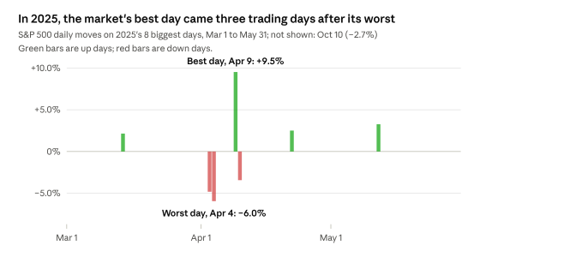
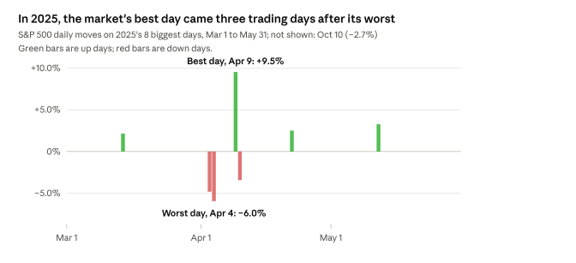
Last year gave us a live example:
S&P 500 daily returns, 2025 (Hartford Funds, data as of January 2026)
In early April 2025, the market fell about 10.5% in two days. Anyone who sold to “get safe” was likely sitting in cash on April 9, when the S&P 500 jumped 9.5% in a single day.[7]
That’s the trap. A retirement plan that depends on knowing exactly when to shift from growth to safety is a plan built on a call nobody can make reliably.
The bottom line: two risks, one pile, no good answer
Let’s put it all together.
- Sequence of returns risk says protect the money you’ll need soon.
- Inflation risk says grow the money you’ll need later.
- Each antidote makes the other risk worse when they live in the same portfolio.
- Market timing can’t bridge the gap, because nobody can reliably call the moment to switch from growth to safety and back again.
So the answer isn’t a better compromise inside one portfolio. The answer is to stop asking one pile of money to do two jobs.
That’s exactly what the bucket strategy does.
Instead of one portfolio fighting itself, you split your savings by when you’ll need the money.
Each pile gets one job and one risk to manage.
Coming up in this series:
- Part 2: Building the Buckets. How each bucket is built and what it’s built to do: the investment goal of each one, the kinds of investments that fit that goal, and how much money each bucket should hold.
- Part 3: Running the Buckets. How the buckets refill in good years, what you do (and don’t do) in a bear market, and how the plan adjusts as your income changes at 62 and beyond.
Don’t wait until your last day to build your buckets
Sequence of returns risk doesn’t give you a grace period to get settled. It starts the day you take your first withdrawal. The time to build your buckets is before you turn in your badge, while you still have a paycheck and time to make changes on your terms, not after the market has made the decision for you.
If you’re a federal LEO within five years of retirement, here’s my challenge: don’t let your TSP keep doing one job when it’s about to have two.
Schedule a Fit Call with Mission Point Planning and Retirement. It’s the first step of our three-step “test drive.” We’ll talk through where your TSP stands today, when you plan to retire, and whether a bucket approach makes sense for you. If it’s a good fit, you’ll see a rough draft of your plan, our Mission Point Field Test, before you ever decide to hire us.
Schedule your Fit Call today →
Frequently asked questions
What is sequence of returns risk?
Sequence of returns risk is the danger that poor market returns early in retirement, while you’re taking withdrawals, permanently shrink your savings. Two retirees can earn the same average return and end up with very different results, depending on when the bad years arrive.
Why can’t one TSP portfolio protect against both sequence risk and inflation?
The fix for each risk works against the other. Protecting your money from market drops means holding safe investments that may not keep up with inflation. Growing your money to beat inflation means owning stocks, which exposes you to market drops at the wrong time.
Should I move my whole TSP to the G Fund when I retire?
Not necessarily. Money you’ll need in the next few years may belong in safe investments, but money you won’t need for 10 or 20 years still has time to grow. Moving everything at once can also lock in whatever the market is doing that week. Talk with a financial professional about what fits your situation.
What is a bucket strategy for retirement?
A bucket strategy divides your savings by when you’ll need the money. Near-term money is kept safe, and long-term money is invested for growth. Each bucket gets one job, so one portfolio isn’t forced to handle two opposite risks. Part 2 of this series covers how each bucket is built.
Sources
All sources accessed November 2, 2026.
- Slickcharts, S&P 500 Total Returns by Year. S&P 500 calendar-year total returns, 2000 to 2019, used in the sequence-of-returns chart. The 7.7% average is the simple average of those 20 returns; the retiree balances are hypothetical calculations from them.
- Congressional Research Service, Retirement Benefits for Federal Law Enforcement Personnel (R42631), September 5, 2017. LEO mandatory retirement at 57, and eligibility at 50 with 20 years of service.
- U.S. Bureau of Labor Statistics CPI-U annual averages, 1985 to 2016, as published by US Inflation Calculator, Historical CPI. Used in the inflation chart. The 2.6% average annual rate and the $85,000 and $134,000 withdrawal figures are calculated from these values.
- U.S. Office of Personnel Management, How is the Cost-of-Living Adjustment (COLA) determined? FERS COLA formula, and the rule that special-provision retirees receive COLAs before age 62.
- The Motley Fool, S&P 500 Annual Returns, updated September 20, 2026, based on Robert Shiller’s data. 1928 to 2025: 9.92% nominal and 6.64% real compound annual return; positive returns in 72 of 98 years.
- J.P. Morgan Asset Management data as reported by CNBC, “Selling out during the market’s worst days can hurt you”, April 7, 2025. $10,000 in the S&P 500, January 3, 2005 to December 31, 2024; seven of the 10 best days within two weeks of the 10 worst.
- Hartford Funds, 2025 Illustrates Why Market Timing Is Impossible, 2026. S&P 500 average annual total returns, 1996 to 2025, and 2025’s largest daily moves, used in the market-timing chart. The two-day April 2025 decline of about 10.5% is calculated from the April 3 and April 4 figures.
With over 21 years of experience as a financial planner, author and educator, Anthony Bucci helps feds “cut through the noise” and make retirement decisions free from opinion, emotion and conjecture. Find out more about Anthony at www.missionpointplan.com.
No strategy assures success or protects against loss. Content in this material is for general information only and not intended to provide specific advice or recommendations for any individual.
The opinions voiced in this material are for general information only and are not intended to provide specific advice or recommendations for any individual.
All performance referenced is historical and is no guarantee of future results. All indices are unmanaged and may not be invested into directly.
The S&P 500 Index is a capitalization-weighted index of 500 stocks designed to measure performance of the broad domestic economy through changes in the aggregate market value of 500 stocks representing all major industries.
The investment types mentioned are examples, not recommendations for any specific person. The sequence-of-returns and inflation illustrations are hypothetical, are shown for illustration only and do not reflect any actual client or investment. They do not include fees, expenses or taxes, which would lower results. All investing involves risk, including possible loss of principal.
The opinions and forecasts expressed are those of the author and may not actually come to pass. This information is subject to change at any time, based on market and other conditions, and should not be construed as a recommendation of any specific security or investment plan. Past performance does not guarantee future results.
Securities and advisory services offered through LPL Financial, a registered investment advisor. Member FINRA/SIPC. LPL Financial and its representatives, Mission Point Planning and Retirement do not provide tax or estate planning advice. These services are provided in conjunction with a qualified tax and/or estate planning professional.
Federal LEO Retirement Security Alert
3 critical mistakes costing federal LEOs thousands each month
Ready to Plan Your Next Mission?
Request your FREE GS-Retirement Blueprint
Similar Posts


FERS Special Reirement Supplement: 3 Planning Issues for LEO’s
By
Anthony Bucci
|
September 15, 2026
|
Reading Time: 8 min readThe FERS Special Retirement Supplement: 3 Planning Issues Every LEO Should Understand Before Retiring If you’re a federal law enforcement…


Becoming a TSP Millionaire isn’t as hard as you think. It is much, much harder.
By
Anthony Bucci
|
February 7, 2024
|
Reading Time: 7 min readBecoming a TSP Millionaire isn’t as hard as you think. It is much, much harder. The news has come out…


The Road to being a TSP Millionaire: Staying Calm
By
Anthony Bucci
|
February 7, 2024
|
Reading Time: 6 min readThe Road to being a TSP Millionaire: Staying Calm The news has come out recently that number of TSP Millionaires…