
Should Federal Employees Invest in Gold in Their TSP?

With gold prices making headlines, many federal employees are asking whether investing in gold through their TSP makes sense.
Let’s walk through what’s driving gold prices, and how this fits into diversification planning for federal employees.
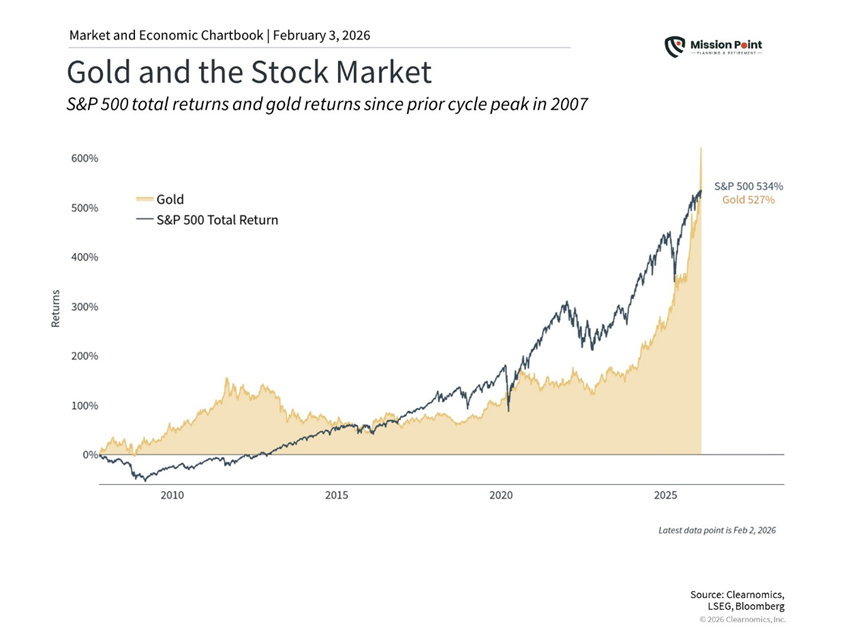
Why Gold Prices Have Been in the Headlines
Gold’s recent rise hasn’t happened by accident. Several powerful forces have converged at the same time:
- Large and growing government deficits
- Heavy government spending
- Ongoing uncertainty around inflation and the long-term value of the U.S. dollar
When confidence in fiscal discipline or currency stability weakens, gold often attracts attention as a potential hedge.
Earlier this year, gold prices surged above $4,300 per ounce before pulling back — an important reminder that gold can be volatile, even when the long-term narrative feels compelling.
Central Banks, Policy Uncertainty, and Gold Demand
Another major driver of gold’s strength has been global central bank demand.
Many countries have been increasing their gold reserves amid geopolitical uncertainty and concerns about long-term currency stability. That institutional buying has helped support higher prices.
At the same time, uncertainty around future monetary policy — particularly as leadership changes approach at the Federal Reserve — has added to market unease. When policy direction feels less predictable, gold often moves back into focus.
What the Gold vs. Interest Rates Chart Is Really Telling Us
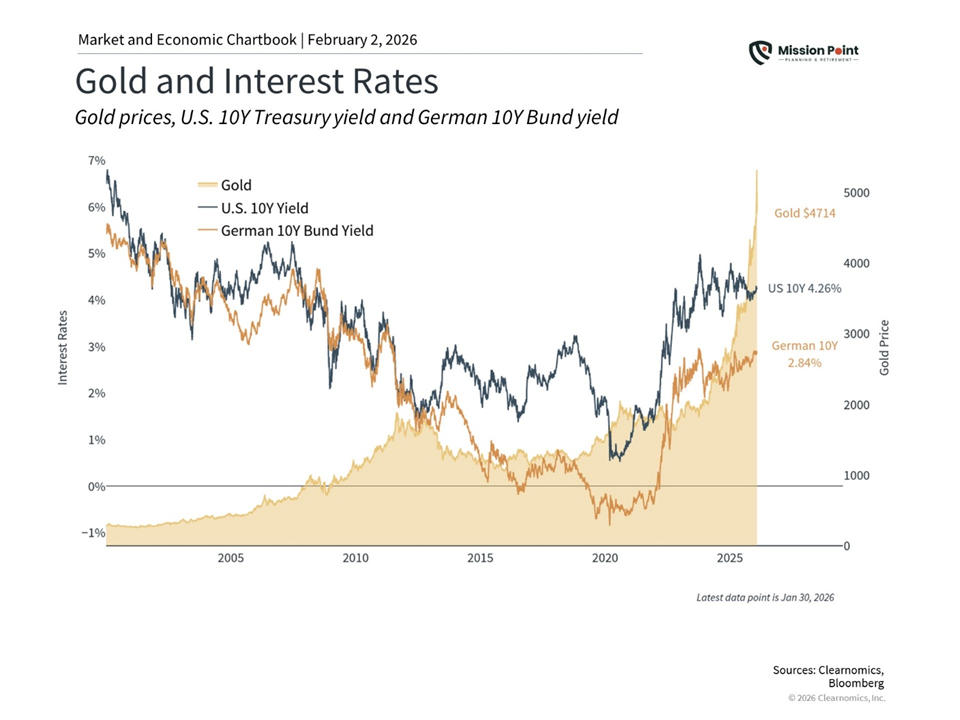
The chart below shows gold prices alongside interest rates — specifically the U.S. 10-year Treasury and the German 10-year bond — over time.
Historically, gold and interest rates tend to move in opposite directions:
- When rates rise, gold often struggles
- When rates fall — or when rate direction is uncertain — gold can benefit
What’s unusual today is that gold has risen sharply even while interest rates remain relatively high.
That tells us this move isn’t just about rates.
Instead, it reflects broader concerns about:
- Fiscal policy
- Global stability
- Long-term confidence in currencies
In other words, investors aren’t buying gold because they expect rates to collapse tomorrow. They’re buying it because they’re seeking diversification during a period of heightened uncertainty — which helps explain both gold’s strength and its volatility.
Where the TSP Fits In — and Where It Doesn’t
The Thrift Savings Plan is an excellent retirement vehicle: low-cost, efficient, and simple.
But it’s also limited by design.
The core TSP funds — G, F, C, S, and I — do not include direct exposure to real assets like gold.* That means federal employees who rely exclusively on the TSP may be heavily concentrated in traditional stocks and bonds.
For some investors, especially during periods of policy uncertainty like today, that raises a reasonable diversification question.
Using the TSP Mutual Fund Window or Outside Accounts for Diversification
For federal employees looking to expand diversification beyond the core TSP funds, there are a couple of common paths.
The TSP Mutual Fund Window
The TSP Mutual Fund Window** provides access to a much broader range of investments, including funds that offer exposure to gold and other real assets.
It’s true that when compared to the near-zero cost of the TSP’s core holdings, the fees associated with the Mutual Fund Window can make even cost-conscious Feds cringe. That reaction is understandable.
However, for larger TSP balances — often north of $500,000 — the ability to add meaningful diversification may outweigh the additional costs. At that level, diversification benefits can matter more than shaving every last basis point off fees.
Outside IRAs
Another option, when eligible, is using an outside IRA to access asset classes not available inside the TSP.
In either case, the goal isn’t to replace the TSP — it’s to thoughtfully complement it.
Closing Thoughts: Gold and Federal Retirement Planning
Gold can be a tool — but only when it’s used in context.
For federal employees, the real planning question isn’t whether gold is “hot.” It’s whether your overall retirement structure — your pension, TSP, and any outside accounts — is properly balanced and diversified.
Successful retirement planning isn’t about reacting to headlines or chasing trends.
It’s about building a strategy designed to hold up across many different market environments — because that’s what leads to long-term confidence and sustainable retirement income.
* https://www.tsp.gov/investment-options/
** https://www.tsp.gov/mutual-fund-window/
Federal LEO Retirement Security Alert
3 critical mistakes costing federal LEOs thousands each month
Ready to Plan Your Next Mission?
Request your FREE GS-Retirement Blueprint
Similar Posts


TSP Diversification: Why Federal Employees May Be Missing the Energy Rally
By
Anthony Bucci
|
April 2, 2026
|
Reading Time: 6 min readWhat the Market Is Really Telling Federal Employees (Hint: It’s Not Just Your TSP Balance) If you’re a federal employee,…


Reflections on 2025 and lessons for 2026
By
Anthony Bucci
|
March 16, 2026
|
Reading Time: 6 min readIn 2026, Don’t forget the Why As I write this, we’re bunkered down in sub-zero temperatures, the holiday season is…


The G Fund Trap: Why Federal Employees Struggle to Become TSP Millionaires
By
Anthony Bucci
|
March 12, 2026
|
Reading Time: 6 min readLast year, I wrote an article called “Becoming a TSP Millionaire Isn’t as Hard as You Think—It’s Much Harder”. In…