
The TSP Bucket Strategy, Part 2: How the 3 Retirement Buckets Work

Part 2 of a three-part series on the TSP bucket strategy for federal law enforcement retirees
Two Risks, One Pile
Where We Left Off
Welcome to Part 2 of our series on the TSP bucket strategy, a straightforward way for federal law enforcement officers to turn their TSP into reliable retirement income. In Part 1, we looked at the two big threats every federal retiree faces and why they pull in opposite directions.
The first is sequence-of-returns risk: the danger of a bad market showing up early in retirement, right when you start pulling money out. The antidote is protection.
The second is inflation, the slow leak that eats your purchasing power. As a federal law enforcement officer retiring under FERS, you may retire in your early 50s and spend 30 or 40 years in retirement. That’s a long time for inflation to work on you. The antidote is growth, and growth comes with market risk.
Here’s the problem, and if you remember one thing from this series, make it this: one pile of money can’t be both the brakes and the gas.
Protection is the brakes. Growth is the gas. Ride the brakes the whole way and inflation slowly pushes you off the road. Floor the gas and one bad stretch at the wrong time puts you in the ditch. And trying to switch pedals at exactly the right moment? That’s market timing, and it’s a coin flip dressed up as a strategy.
The Solution: Give Each Pile of Money One Job
So what’s the fix? It’s almost too simple: stop asking one pile of money to do more than one job.
Instead, split your money into separate piles. We call them buckets, and each one gets two things:
- A specific investment objective. Is this money here to stay safe, to produce income, or to grow?
- A specific time horizon. When will you actually need to spend it?
The time horizon is the key. Money you’ll spend next year and money you won’t touch for 15 years face completely different risks, so they shouldn’t be invested the same way. Short-term money’s biggest enemy is a market crash. Long-term money’s biggest enemy is inflation. Separate them by when they’ll be spent, and each pile only has one enemy to fight.
Welcome to time segmentation. That’s all the bucket strategy really is: matching each dollar to the job it has to do and the date it has to do it by. The brakes get their own pile. The gas gets its own pile. And neither one has to compromise for the other.
So in Part 2, we’re opening the hood. I’ll walk you through each of the three retirement buckets, the job each one does, and how each one is invested.
How the TSP Bucket Strategy Works: Sort Your Money by When You’ll Spend It
The bucket strategy comes down to one simple question: when will you need this money?
First, who this is for. The bucket strategy is built for people who want their TSP to be a real source of income, a paycheck that stands on equal footing with the FERS annuity and Social Security. Not a rainy-day fund you’re afraid to touch, and not an account you dip into whenever something comes up. A third paycheck, steady and dependable, designed to last.
Every dollar in your investment portfolio gets one of three assignments:
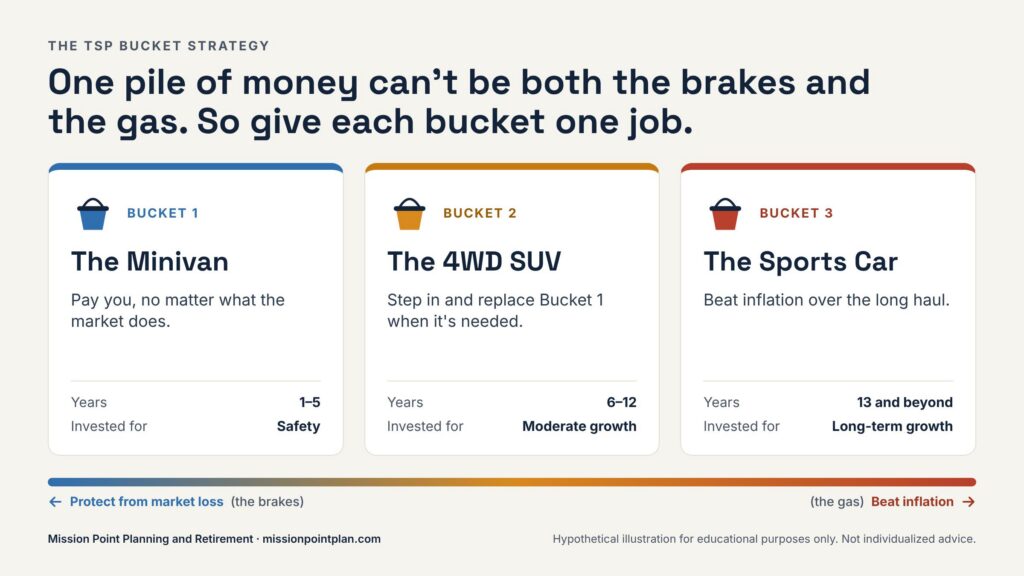
- Bucket 1: money you’ll spend in years 1 through 5
- Bucket 2: money you’ll spend in years 6 through 12
- Bucket 3: money you won’t need until year 13 and beyond
I’m from the Motor City, so I think of the buckets like vehicles. You wouldn’t ask the minivan to do what the sports car does, and you wouldn’t haul a load of lumber in the sports car. Each one is built for a specific job:
- Bucket 1 is the minivan. Safe, reliable, and it gets the family where it needs to go every single day.
- Bucket 2 is the four-wheel-drive SUV. Versatile enough to haul lumber on Saturday, take the kids to soccer on Sunday, or get a wash and look sharp for a night on the town. Not quite a work truck, not quite a luxury car, and that’s exactly why it can handle a little of everything.
- Bucket 3 is the sports car. Built for performance over the long road. The ride can get bumpy, so it’s not what you take to the grocery store.
Bucket 1: Short-Term Safety (The Minivan), Years 1–5
Bucket 1 has one job: pay you, no matter what the market is doing.
It holds about five years of the withdrawals you expect to take from your TSP and other retirement savings. The money is invested for safety, in things like the TSP G Fund and other safe, stable investments. It won’t grow much, and that’s the point. Bucket 1 isn’t there to make you rich. It’s there to make sure a bad year in the market never forces you to sell.
Why five years? It isn’t a magic number, but it’s long enough to cover most market downturns. And if a downturn runs longer than that, Bucket 2 is standing right behind it.
The real value of Bucket 1 is as much mental as it is financial. When the headlines get ugly and the market is down 25%, you already know your next five years of paychecks are sitting in safe investments. That’s the difference between watching a storm from inside the house and standing out in it.
Bucket 2: Moderate Growth (The Four-Wheel-Drive SUV), Years 6–12
Bucket 2 holds the money you’ll need in years 6 through 12. It isn’t quite aggressive, and it isn’t quite conservative. It sits right in the middle, invested for moderate growth, with a possible focus on investments that also pay dividends and interest.
But what makes Bucket 2 unique isn’t how it’s invested. It’s the role it plays: Bucket 2 is built to replace Bucket 1.
Think about it. Over the next five years, the money in Bucket 1 gets spent. Something has to step in and take its place, and that’s Bucket 2’s job. It grows enough to keep up while it waits, but stays steady enough to be ready when it’s called on to become your next five years of paychecks.
That middle-of-the-road positioning is exactly why it can do the job. If Bucket 2 were as conservative as Bucket 1, it wouldn’t grow enough over that many years. If it were as aggressive as Bucket 3, it might be down 30% right when you need it. Moderate is the point.
How Bucket 2 actually refills Bucket 1, in good markets and bad, is where the strategy really earns its keep. We’ll get into those mechanics in Part 3.
This is a general description for educational purposes, not a recommendation for any particular investment or style. The right mix for Bucket 2 depends on your own situation, goals, and risk tolerance.
Bucket 3: Long-Term Growth (The Sports Car), Year 13 and Beyond
Bucket 3 is your long-term money, what we call the Inflation Buster. It’s the money you won’t touch for at least 12 years, so it can afford to ride out the market’s ups and downs. It’s invested for growth and spread across different kinds of investments, because its job is to outrun inflation over the long haul.
But for Bucket 3 to work, it needs more than time. It needs patience.
Think back to how you treated your TSP 12 years before you retired. You didn’t panic over every dip, because you knew that money had years to recover before you’d need it. Bucket 3 asks you to think exactly the same way. You may be retired now, but this is still long-term money.
So what gives you the patience to ride it out? Buckets 1 and 2. When your next 12 years of paychecks are already potentially set aside, a rough year for the sports car is just a bumpy stretch of road, not an emergency. That’s the real payoff of the strategy: the first two buckets give the third one the time and the patience it needs to do its job.
Quick Example: Filling the Buckets
Hypothetical: You retire with $1 million in your TSP and want it to pay you $40,000 a year.
| Bucket | Vehicle | Its job | Years covered | Amount |
| Bucket 1 | Minivan | Pay you, no matter what | Years 1–5 (5 years × $40,000) | $200,000 |
| Bucket 2 | Four-wheel-drive SUV | Step in and replace Bucket 1 | Years 6–12 (7 years × $40,000) | $280,000 |
| Bucket 3 | Sports car | Beat inflation over the long haul | Year 13 and beyond | $520,000 |
| Total | $1,000,000 |
Your real numbers will look different, but that’s the shape of it.
What’s Next: Putting the Buckets to the Test
The TSP bucket strategy gives every dollar of your retirement savings a job. Bucket 1 is your brakes, protecting your paycheck from sequence risk. Bucket 3 is your gas, fighting inflation. Bucket 2 connects the two and keeps money flowing in the right direction. One pile can’t be both the brakes and the gas, but three buckets can.
But a strategy is only as good as how it’s managed. So far, we’ve covered what the buckets are and how each one is invested. In Part 3, we’ll shift to how we actually run them:
- What happens when Bucket 1 starts running low
- What happens when Bucket 3 strings together several strong growth years in a row
- How the buckets hold up when the market drops 30%, and why a written bear market policy before the storm makes all the difference
And one more, with apologies to the TSP fans out there: you can’t run a true bucket strategy inside the TSP. We’ll explain why in Part 3.
If you’re a federal law enforcement officer within five years of retirement and want to see what your own TSP buckets would look like, let’s talk. Schedule a Fit Call and we’ll map it out together.
With over 21 years of experience as a financial planner, author and educator, Anthony Bucci helps feds “cut through the noise” and make retirement decisions free from opinion, emotion and conjecture. Find out more about Anthony at www.missionpointplan.com.
No strategy assures success or protects against loss. Content in this material is for general information only and not intended to provide specific advice or recommendations for any individual. The opinions voiced in this material are for general information only and are not intended to provide specific advice or recommendations for any individual. All performance referenced is historical and is no guarantee of future results. All indices are unmanaged and may not be invested into directly. The S&P 500 Index is a capitalization-weighted index of 500 stocks designed to measure performance of the broad domestic economy through changes in the aggregate market value of 500 stocks representing all major industries.
The investment types mentioned are examples, not recommendations for any specific person. The sequence-of-returns and inflation illustrations are hypothetical, are shown for illustration only and do not reflect any actual client or investment. They do not include fees, expenses or taxes, which would lower results. All investing involves risk, including possible loss of principal.
The opinions and forecasts expressed are those of the author and may not actually come to pass. This information is subject to change at any time, based on market and other conditions, and should not be construed as a recommendation of any specific security or investment plan. Past performance does not guarantee future results.
Federal LEO Retirement Security Alert
3 critical mistakes costing federal LEOs thousands each month
Ready to Plan Your Next Mission?
Request your FREE GS-Retirement Blueprint
Similar Posts


Retiring as a Federal LEO? Why Your TSP Needs a Bucket Strategy
By
Anthony Bucci
|
November 4, 2026
|
Reading Time: 12 min readPart 1 of a three-part series on the TSP bucket strategy for federal law enforcement retirees Two Risks, One Pile…


FERS Special Reirement Supplement: 3 Planning Issues for LEO’s
By
Anthony Bucci
|
September 15, 2026
|
Reading Time: 8 min readThe FERS Special Retirement Supplement: 3 Planning Issues Every LEO Should Understand Before Retiring If you’re a federal law enforcement…


Becoming a TSP Millionaire isn’t as hard as you think. It is much, much harder.
By
Anthony Bucci
|
February 7, 2024
|
Reading Time: 7 min readBecoming a TSP Millionaire isn’t as hard as you think. It is much, much harder. The news has come out…