
TSP Diversification: Why Federal Employees May Be Missing the Energy Rally

What the Market Is Really Telling Federal Employees (Hint: It’s Not Just Your TSP Balance)
If you’re a federal employee, you’ve probably noticed your TSP hasn’t felt great lately—even with all the headlines about certain parts of the market doing well.
Here’s what’s interesting:
Oil prices are rising.
Energy stocks are up big.
And yet… most TSP investors aren’t really benefiting.
That disconnect tells us something important.
Because right now, the story of the market isn’t just “up or down”—it’s about what’s driving returns… and what isn’t.
And for many federal employees, it’s exposing a hidden issue:
your TSP may not be as diversified as you think.
A Market Pullback… That Doesn’t Tell the Whole Story
Recently, the S&P 500 experienced its first pullback of more than 5% from its all-time high.
Sounds concerning, right?
Here’s the twist: more than half of the sectors—6 out of 11—are still positive this year.
So how can the market be down while so much of it is doing well?
It comes down to weighting.
Technology now makes up nearly one-third of the S&P 500, which means your C Fund is heavily influenced by a relatively small group of companies.
So when tech stumbles, your account can feel it—even if other parts of the market are doing just fine.
This is one of the biggest blind spots we see with federal employees:
The C Fund feels diversified… but it’s become increasingly concentrated.
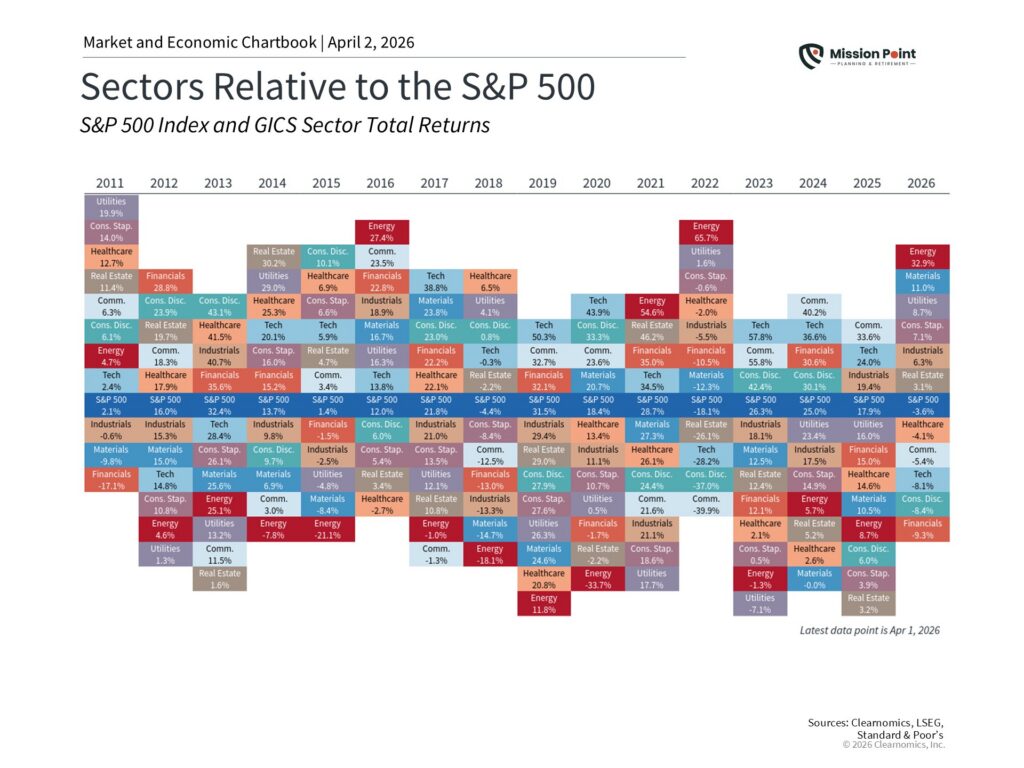
Energy Is Leading… and Most TSP Investors Don’t Own Much of It
One of the biggest stories in 2026 so far? Energy.
The sector is up roughly 30% year-to-date, driven largely by geopolitical tensions in the Middle East and rising oil prices.
We’ve seen this before:
- In 2022 (Russia–Ukraine), energy surged while the broader market declined
- In 2021, energy led as the economy rebounded
Energy tends to benefit from geopolitical stress.
But here’s the issue for many federal employees:
The TSP has very limited exposure to energy.
So while energy stocks are rising, many TSP investors aren’t fully participating in that upside.
At the same time, higher oil prices can weigh on the broader economy—impacting many of the large companies that dominate the C Fund.
So you end up in a situation where:
- You’re missing some of the gains
- But still feeling the downside pressure
AI Isn’t Going Away… But It’s Creating Concentration Risk
Over the past few years, AI has been the dominant story in the market.
And if you own the C Fund, you’ve benefited—because a handful of large tech companies have driven a significant portion of returns.
But that success has created a new issue:
Concentration.
At one point this past year, the top 10 companies made up nearly 40% of the entire S&P 500.**
Think about that.
In an index of 500 companies, just 10 are driving almost 1/2 the results.
That’s not just “growth exposure.”
That’s dependence on a very small group of stocks.
And when leadership shifts—as it always does—those portfolios can feel it the most.
The Real Lesson: What This Year Is Actually Teaching Us
If your takeaway is, “we should be moving everything into energy right now,” or “let’s move it to the G and wait it out’ that’s exactly the trap investors fall into.
Let’s go back just 8 weeks.
Was it on your radar—or anyone’s—that the U.S. and Israel would strike Iran?
Nope.
Go back three months and look at the market forecasts from the biggest Wall Street firms—the collective brainpower of decades of experience, CFAs, PhDs in economics. You’d be hard-pressed to find anyone predicting this exact scenario… and the market reaction that followed.
And yet, turn on financial TV today and you’ll see something interesting.
They’re bringing on anyone who even hinted they saw it coming—you almost get the sense they had to comb the internet to find them. Meanwhile, others are explaining the situation in a way that sounds perfectly logical… maybe even inevitable.
“Of course this was going to happen.”
“Of course the market would react this way.”
“Of course AI would disrupt these companies.”
It all makes perfect sense—after the fact.
It reminds me of a quote from Daniel Kahneman:
“The idea that the future is unpredictable is undermined every day by the ease with which the past is explained.”
That’s the real lesson.
The events that move markets the most are often the ones no one sees coming—especially the experts.
And as much as financial TV likes to debate what the market will do next, we believe that’s largely a fool’s errand.
The world is inherently unpredictable.
Which is exactly why diversification matters.
At its core, diversification is a simple admission:
we don’t know what’s going to happen next.
And because we don’t know, the best approach is to hedge our bets—to spread risk across different parts of the market rather than relying on any single outcome to be right.
Now, that doesn’t mean we ignore what’s happening now.
Something you can take away from today’s market.
If we zoom out just a bit, and without the need to predict, one thing has been clear over the past five years—the market has become more concentrated, not less.
At one point this past year, the top 10 companies made up nearly 40% of the entire S&P 500. A little over 10 years ago that number was in the teens.*
Think about that.
In an index of 500 companies, just 10 were driving almost half the results.
And since your C Fund tracks the S&P 500, that concentration flows directly into your portfolio.
That’s not just “tech-heavy.”
That’s top-10-stock-heavy.
So even if you think you’re diversified because you own the index, there’s a very real chance your portfolio is more concentrated than you realize.
Which brings us to a simple gut-check:
- How concentrated is your TSP?
- How much are you relying on the C Fund?
- Do you have exposure beyond just large U.S. stocks?
If the answers are “a lot,” “heavily,” and “not much,” you may not be as prepared as you think for the next market shift.
Not because a downturn is guaranteed.
But because when leadership changes—and it always does—concentrated portfolios tend to feel it the most.
A Practical Step: Look Beyond the Core TSP Funds
So what can you actually do about this?
If that gut-check gave you pause—even a little—this is where it becomes actionable.
One option worth revisiting is the TSP mutual fund window.
Now, I know—there are additional fees involved. And for a long time, that alone was enough for many people to dismiss it.
But it may be worth taking a second look.
Because the ability to add true diversification—beyond just large U.S. stocks—can be meaningful, especially in a market that has become increasingly concentrated.
In the right situation, the benefits of expanding your investment options may far outweigh the additional costs.
This isn’t a blanket recommendation for everyone.
But it is a reminder that if your portfolio is heavily tied to the C Fund, you may have more tools available than you realize.
Final Thought
If you’re not sure how diversified your TSP really is—or whether it’s positioned to handle the next shift in the market—that’s exactly the kind of conversation we should be having.
👉 You can start by scheduling a quick Fit Call, and we’ll walk through it together.
* www.TSP.gov
**Source: FactSet, Standard & Poor’s, J.P. Morgan Asset Management. Guide to the Markets – U.S. Data are as of March 27, 2026.

Federal LEO Retirement Security Alert
3 critical mistakes costing federal LEOs thousands each month
Ready to Plan Your Next Mission?
Request your FREE GS-Retirement Blueprint
Similar Posts


Should Federal Employees Invest in Gold in Their TSP?
By
Anthony Bucci
|
February 3, 2026
|
Reading Time: 4 min readWith gold prices making headlines, many federal employees are asking whether investing in gold through their TSP makes sense. Let’s…


Reflections on 2025 and lessons for 2026
By
Anthony Bucci
|
March 16, 2026
|
Reading Time: 6 min readIn 2026, Don’t forget the Why As I write this, we’re bunkered down in sub-zero temperatures, the holiday season is…


The G Fund Trap: Why Federal Employees Struggle to Become TSP Millionaires
By
Anthony Bucci
|
March 12, 2026
|
Reading Time: 6 min readLast year, I wrote an article called “Becoming a TSP Millionaire Isn’t as Hard as You Think—It’s Much Harder”. In…