
Think the TSP Is Cheap? Think Again. The Hidden Cost of Dollar Cost Ravaging.

You spent decades building your TSP. Now discover how its withdrawal rules could quietly eat away at your retirement savings.
Great Engine, No Brakes
If you’ve spent a career in federal law enforcement, the Thrift Savings Plan has probably been one of the best deals in your benefits package. It’s low cost and easy to use, and your agency kicks in matching contributions.* For building a nest egg, it’s hard to beat.
But (there’s always a “but,” right?) the TSP was built to accelerate, not to brake. It does a fantastic job helping you pile money up. It does a much worse job helping you take money out once you’ve turned in your badge and credentials.
And here’s the catch: The TSP’s low fees don’t tell the whole story. There’s a potential cost in retirement that you’ll never see on your statement.
Why? It comes down to a problem that kicks in the day you start taking withdrawals. It’s called Dollar Cost Ravaging, and most feds have never heard of it.
This matters more for you than for the average fed. Most LEOs retire somewhere between 50 and 57. That means the TSP may need to fund 35 or 40 years of retirement, not 20 or 25. It often has to carry a bigger share of the load early on, before Social Security starts. More years of withdrawals means more chances for Dollar Cost Ravaging to do damage.
First, the Good Twin: Dollar Cost Averaging
You’ve been doing this your whole career, whether you knew it or not. Every pay period, a set amount goes into your TSP no matter what the market is doing. That’s Dollar Cost Averaging (DCA).
The beauty of it is simple. When prices are high, your contribution buys fewer shares. When prices drop, the same dollars buy more. Volatility actually works in your favor.
Here’s a hypothetical example. You invest $1,000 a month for six months. The share price starts at $10, drops as low as $5, and climbs back to $10.
| Month | Share price | Invested | Shares bought | Total shares | Account value |
| 1 | $10 | $1,000 | 100 | 100 | $1,000 |
| 2 | $8 | $1,000 | 125 | 225 | $1,800 |
| 3 | $5 | $1,000 | 200 | 425 | $2,125 |
| 4 | $8 | $1,000 | 125 | 550 | $4,400 |
| 5 | $10 | $1,000 | 100 | 650 | $6,500 |
| 6 | $10 | $1,000 | 100 | 750 | $7,500 |
Hypothetical illustration only. It does not represent any actual investment and does not reflect fees or taxes.
The price ended exactly where it started. You’d think you broke even, right? Nope. You put in $6,000 and walked away with $7,500, because you bought twice as many shares in the month the price was cut in half. That’s “buy low” working on autopilot.
Now Meet the Evil Twin: Dollar Cost Ravaging
In retirement, the whole process runs in reverse. For 20-plus years you traded paychecks for shares. Now you’re trading shares back for paychecks.
Your FERS annuity and the Special Retirement Supplement (and later Social Security) cover part of your income. The TSP is designed to fill in the rest. To produce that monthly income, the TSP has to sell shares every single month. When prices drop, it has to sell more of them to raise the same dollars.
That’s Dollar Cost Ravaging (DCR). The same volatility that helped you as a buyer now works against you as a seller.
You’re not withdrawing money. You’re selling ownership.
Here’s the part most people miss. Your TSP isn’t a bank account. When you take money out of a bank account, you just have fewer dollars. When you take money out of the TSP, you’re selling shares. You’re trading your ownership in the fund for cash.
Every share you sell is a share you no longer own. It won’t grow, it won’t recover, and it won’t compound for you ever again. Every withdrawal shrinks your slice of the pie.
To see why that matters, let’s trade the TSP for a farm.
The Cow Herd: Dollar Cost Ravaging in Action
Imagine that instead of buying TSP shares for 25 years, you bought cows. By retirement you’ve built a herd of 20 cows, and each one is worth $2,000 at the market. Your herd is worth $40,000.
Your cows produce milk, and they have calves that grow into more cows. That’s your growth and compounding. In retirement, you rely on the herd to pay the bills. Each month you sell a few cows to a younger, up-and-coming farmer at the going market price.
You need $4,000 a month. At $2,000 a cow, that’s two cows a month.
Then a rumor hits the county: mad cow disease. Nobody knows if it’s true, but cow prices drop 30% overnight to $1,400. Your bills don’t care about the rumor. The mortgage is still due. To raise $4,000, you now have to sell three cows a month.
Two months later, the rumor turns out to be false. Cow prices go right back to $2,000. You feel pretty good, since the market recovered.
But count your herd. Without the rumor, you’d have sold 4 cows and have 16 left. Because of the rumor, you sold 6 and have 14 left. You’re down two cows.
Those two cows aren’t coming back when the price does. That’s two fewer cows giving milk, two fewer cows having calves, and $4,000 less herd at full price. And it’s a smaller herd that has to carry you for the next 30-plus years.
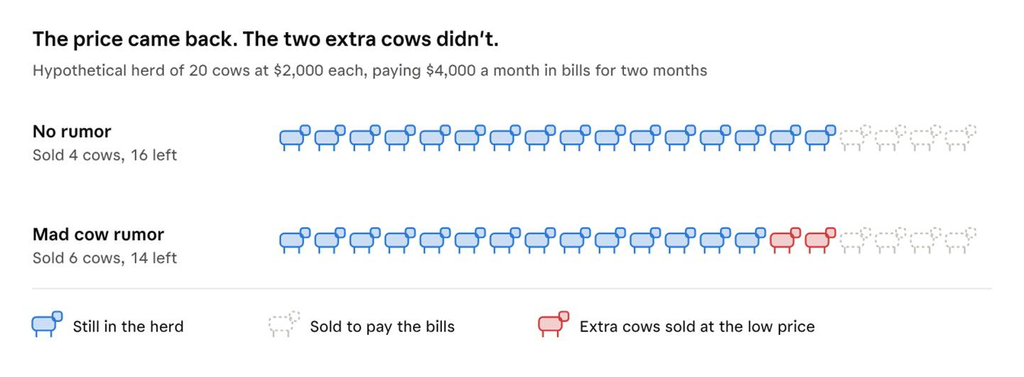
Same herd, same bills, same price at the end. The only difference is the two cows sold at the bottom. That’s Dollar Cost Ravaging, and your TSP shares work exactly the same way.
Let’s run the exact same market in reverse. This time you start with 600 shares worth $6,000 and withdraw $1,000 a month.
| Month | Share price | Withdrawn | Shares sold | Shares left | Account value |
| 1 | $10 | $1,000 | 100 | 500 | $5,000 |
| 2 | $8 | $1,000 | 125 | 375 | $3,000 |
| 3 | $5 | $1,000 | 200 | 175 | $875 |
| 4 | $8 | $1,000 | 125 | 50 | $400 |
| 5 | $10 | $500 | 50 | 0 | $0 |
| 6 | $10 | $0 | 0 | 0 | $0 |
Hypothetical illustration only. It does not represent any actual investment and does not reflect fees or taxes.
If the price had just sat at $10, you’d have collected all $6,000. Instead, you collected $4,500, and the account was empty before month 6. The same market that made the buyer $1,500 cost the seller $1,500.
The problem is month 3. You were forced to dump 200 shares at the bottom. Those shares weren’t around for the rebound. Instead of buying low, you sold low.
Why the TSP Makes It Worse
Every retirement account faces Dollar Cost Ravaging. But the TSP has a rule that pours gas on it.
You can’t choose which fund to sell
Think about how you’d plan an entry. You don’t send every member of the team through the door at once. You decide who goes first and who holds back.
The TSP doesn’t let you make that call. Every withdrawal comes out of your funds proportionally. Say your account is 60% C Fund and 40% G Fund. Every withdrawal comes out 60% from the C Fund and 40% from the G Fund, whether the market is up 20% or down 30%. You can choose whether a withdrawal comes from your traditional or Roth balance, but not which fund it comes from. As of 2026, that rule is still in place.
That’s a problem because the C Fund tracks the S&P 500. It’s built for growth, and it’s far more volatile than the G Fund. In a downturn, the smart move is usually to pull from the stable money and leave the growth money alone to recover. Outside the TSP, you can do exactly that. Inside it, the C Fund gets sold every month no matter what.
“Can’t I just work around it?”
You may have heard of the interfund transfer “workaround.” You take your normal withdrawal, which sells 60% C Fund and 40% G Fund. Then you do an interfund transfer to move money from the G Fund back into the C Fund, so it looks like the withdrawal came from the G Fund alone.
On paper, it works. In real life, it falls apart:
- It’s 100% manual. Nothing about it is automatic. Someone has to log in and do it after every single withdrawal, for the next 35 or 40 years. Miss a month, and you just sold C Fund shares at the bottom anyway.
- It burns your interfund transfers. The TSP gives you only two unrestricted interfund transfers per month. After that, you can only move money into the G Fund. Using them to patch every withdrawal leaves you nothing for anything else.
- The market moves faster than the TSP does. An interfund transfer isn’t a trade you place in real time. Submit it before noon Eastern and it posts at that day’s closing price. Submit it after noon and it waits until the next business day. Your withdrawal and your transfer are two separate transactions on two separate days, and you won’t know either price until it’s done.
- It breaks down when it matters most. The workaround matters most in a falling market, and that’s exactly when prices swing hardest from one day to the next.
How fast? J.P. Morgan Asset Management’s Guide to Retirement has found that most of the stock market’s 10 best days over the past 20 years came within two weeks of its 10 worst days. In March 2020, the second-worst day of the year (March 12) was followed the very next day by the second-best day of the year. In a market like that, a one-day lag between your withdrawal and your transfer can mean selling on the worst day and buying back on the best one, which is the exact opposite of what you wanted.
A plan that only works if you never miss a step for four decades isn’t a plan. It’s a patch.
What You Can Do About It
You can’t control the market. But you can control how you take money out of it. Here are your options:
- Call your representatives (and the TSP). Seriously. Ask them to let retirees choose which fund a withdrawal comes from. Until that happens, keep reading.
- Consider rolling some or of your TSP to an IRA. At many IRA providers, you choose which investment to sell for each withdrawal. That lets you draw from your stable money in a downturn and leave your growth money alone to recover. This is a big decision with real trade-offs. You’d give up the TSP’s very low costs and the G Fund, which isn’t available anywhere else. Compare costs and features carefully before you move anything.
- Build a withdrawal strategy, not just a withdrawal. Keep a stable reserve to draw from in down years and refill it from growth investments when markets are up, on your schedule, not the market’s. That’s the core idea behind the bucket strategy.
The Bottom Line
The TSP is a fantastic vehicle for getting you to retirement. It just wasn’t built with good brakes for the trip after. If you’re within five years of your retirement date, now is the time to plan how you’ll take money out, not just how much you’ve saved.
You spent a career making sure nothing caught you off guard. Your retirement income deserves the same planning.
*Agency matching contributions apply to FERS employees.
With over 21 years of experience as a financial planner, author and educator, Anthony Bucci helps feds “cut through the noise” and make retirement decisions free from opinion, emotion and conjecture. Find out more about Anthony at www.missionpointplan.com.
No strategy assures success or protects against loss. This material is for general information only and is not intended to provide specific advice or recommendations for any individual. There is no assurance that the views or strategies discussed are suitable for all investors or will yield positive outcomes. Investing involves risks including possible loss of principal. All performance referenced is historical and is no guarantee of future results. The examples in this article are hypothetical illustrations and do not reflect fees, expenses or taxes. Opinions expressed are subject to change and may not come to pass.
This information is not intended to be a substitute for specific individualized tax or legal advice. We suggest that you discuss your specific situation with a qualified tax or legal advisor.
The Standard & Poor’s 500 Index (S&P 500) is a capitalization-weighted index of 500 stocks designed to measure performance of the broad domestic economy through changes in the aggregate market value of 500 stocks representing all major industries. Indexes are unmanaged and cannot be invested into directly.
Dollar cost averaging involves continuous investment in securities regardless of fluctuation in price levels of such securities. An investor should consider their ability to continue purchasing through fluctuating price levels. Such a plan does not assure a profit and does not protect against loss in declining markets.
Before deciding whether to keep assets in the TSP or roll them over to an IRA, an investor should consider various factors, including but not limited to investment options, fees and expenses, services, withdrawal penalties, protection from creditors and legal judgments, required minimum distributions and possible tax consequences. Rolling over is not right for everyone.
The Thrift Savings Plan is administered by the Federal Retirement Thrift Investment Board, which is not affiliated with LPL Financial or Mission Point Planning and Retirement. J.P. Morgan Asset Management is not affiliated with LPL Financial. Third-party information is believed to be reliable but its accuracy is not guaranteed.
The cow herd example is an analogy for illustration only and does not represent any actual investment.
Securities and advisory services offered through LPL Financial, a registered investment advisor. Member FINRA/SIPC. LPL Financial and its representatives, Mission Point Planning and Retirement do not provide tax or estate planning advice. These services are provided in conjunction with a qualified tax and/or estate planning professional.
Sources
- TSP: withdrawals come out proportionally across funds (TSP email bulletin)
- 5 CFR 1601, Subpart D: interfund transfer posting rules (eCFR)
- FedWeek: the interfund transfer workaround
- J.P. Morgan 2024 Guide to Retirement: best days near worst days (401k Specialist)
- J.P. Morgan Asset Management: navigating market volatility
- March 12, 2020 followed by the year’s second-best day (IBTimes)
Federal LEO Retirement Security Alert
3 critical mistakes costing federal LEOs thousands each month
Ready to Plan Your Next Mission?
Request your FREE GS-Retirement Blueprint
Similar Posts


The TSP Bucket Strategy, Part 2: How the 3 Retirement Buckets Work
By
Anthony Bucci
|
November 18, 2026
|
Reading Time: 8 min readPart 2 of a three-part series on the TSP bucket strategy for federal law enforcement retirees Two Risks, One Pile…


Retiring as a Federal LEO? Why Your TSP Needs a Bucket Strategy
By
Anthony Bucci
|
November 18, 2026
|
Reading Time: 12 min readPart 1 of a three-part series on the TSP bucket strategy for federal law enforcement retirees Two Risks, One Pile…


What Your Annual Leave Payout Can (and Can’t) Do for a Retiring LEO
By
Anthony Bucci
|
September 15, 2026
|
Reading Time: 6 min readIf you’re a federal law enforcement officer getting close to retirement and you’ve built up a healthy annual-leave balance, you’re…